
The New Oxford Annotated Bible (NOAB) PDF: A Comprehensive Guide
The NOAB PDF offers a digitally accessible, ecumenical study resource, favored by scholars and readers alike for over half a century.
What is the New Oxford Annotated Bible?
The New Oxford Annotated Bible (NOAB) is a comprehensive, scholarly study Bible renowned for its detailed annotations and ecumenical perspective. Available in PDF format, it provides students, clergy, and interested readers with an unparalleled resource for biblical study.
It features the New Revised Standard Version translation, extensive notes, essays, maps, and timelines, making it a trusted tool for understanding the biblical text within its historical and literary contexts.
History and Editions of the NOAB
The NOAB has a rich history, evolving through several editions to remain a leading study Bible. The first edition established its scholarly approach, with subsequent revisions incorporating new discoveries and interpretations.
The PDF versions reflect these updates, offering access to the latest scholarship. Its enduring popularity, spanning over 50 years, demonstrates its value as a reliable and insightful biblical resource.
First Edition and Subsequent Revisions
The initial NOAB set a high standard for annotated Bibles, quickly becoming a staple for academic study. PDF accessibility broadened its reach. Later revisions meticulously integrated evolving biblical scholarship and archaeological findings.
Each update to the NOAB PDF refined annotations, essays, and supplementary materials, ensuring continued relevance. These revisions demonstrate a commitment to providing the most current and comprehensive biblical resource available.
The Fourth Edition and its Significance
The fourth edition NOAB PDF represents a landmark achievement, fully revised to reflect decades of new scholarship. Its significance lies in the comprehensive updates to annotations, essays, and introductory materials.
This edition maintains the ecumenical approach while offering enhanced tools for deeper biblical understanding. The PDF format ensures wider accessibility, making this invaluable resource available to students, clergy, and individuals globally.
Key Features of the NOAB
The NOAB PDF distinguishes itself through several key features. Primarily, it utilizes the New Revised Standard Version (NRSV) translation, known for its accuracy and readability.
Furthermore, its extensive annotation system, including footnotes and insightful essays, provides crucial context. The PDF version preserves these elements, offering a robust study experience with maps, timelines, and a comprehensive glossary readily available.
The New Revised Standard Version (NRSV) Translation
The NOAB PDF employs the New Revised Standard Version (NRSV), a translation celebrated for its balance of accuracy, clarity, and literary quality. This version aims for faithfulness to the original Hebrew, Aramaic, and Greek texts.
Within the PDF format, the NRSV’s nuanced language is preserved, making complex biblical passages more accessible to a wide range of readers, from scholars to individual study enthusiasts.

Extensive Annotation System
The NOAB PDF distinguishes itself through a remarkably comprehensive annotation system. These annotations, accessible within the digital format, provide historical, literary, and theological insights directly alongside the biblical text.
The PDF allows users to easily navigate these notes, fostering deeper understanding and critical engagement with scripture. Scholars appreciate the resources for forming informed opinions.
The Apocrypha Inclusion

The NOAB PDF notably includes the Apocrypha, texts considered canonical by some Christian traditions but not others. This inclusion provides a broader historical and literary context for understanding the development of the biblical canon.
The PDF format allows seamless access to these texts alongside the protocanonical books, facilitating comparative study and a more nuanced understanding of scripture.
What is the Apocrypha?
Within the NOAB PDF, the Apocrypha comprises a collection of ancient texts – books like Tobit, Judith, and Maccabees – that were included in the Septuagint, the Greek translation of the Hebrew Bible.
These texts aren’t part of the Hebrew Bible canon, and their status varies among Christian denominations. The NOAB PDF presents them for scholarly exploration and contextual understanding.
Significance of Including the Apocrypha in NOAB
The NOAB PDF’s inclusion of the Apocrypha provides a broader historical and literary context for understanding the development of biblical thought. It allows readers to explore diverse perspectives and traditions.
This comprehensive approach reflects the NOAB’s ecumenical nature, offering valuable insights into the complex relationship between different scriptural canons and their interpretations.
Editorial Team and Contributors
The NOAB PDF benefits from a distinguished editorial team, ensuring scholarly rigor and comprehensive coverage. Michael Coogan serves as the General Editor, guiding the project’s overall vision.
Marc Brettler, Carol Newsom, and Pheme Perkins are key contributors, bringing expertise in diverse biblical fields. Their collective knowledge elevates the NOAB as a trusted resource.
Michael Coogan: General Editor
Michael Coogan, as General Editor of the NOAB PDF, provides crucial leadership and oversight. His expertise ensures the Bible’s scholarly integrity and accessibility. He guides the team in presenting a balanced and informed perspective.
Coogan’s dedication to biblical studies is evident throughout the NOAB, making the PDF version a valuable tool for students, clergy, and general readers seeking deeper understanding.
Marc Brettler, Carol Newsom, and Pheme Perkins: Key Contributors
Marc Brettler, Carol Newsom, and Pheme Perkins are pivotal contributors to the NOAB PDF’s success. Their combined expertise in Hebrew Bible, Old Testament, and New Testament studies enriches the annotations and essays.
These scholars ensure the NOAB PDF remains a respected resource, offering nuanced interpretations and historical context for a comprehensive biblical experience.
NOAB as a Study Tool
The NOAB PDF excels as a study tool, providing students, professors, and clergy with unparalleled resources. Its extensive annotations, essays, maps, and timelines facilitate in-depth biblical analysis.
Whether for academic coursework or individual exploration, the NOAB PDF’s scholarly apparatus empowers users to engage critically with scripture and deepen their understanding.
Use in Academic Settings
The NOAB PDF is a mainstay in theological education, equipping students with the necessary tools for rigorous biblical study. Its comprehensive notes encourage critical thinking, allowing students to form informed opinions.
Professors value the NOAB PDF’s scholarly rigor and ecumenical perspective, fostering robust classroom discussions and insightful research. It’s a trusted resource for advanced analysis.
Benefits for Individual Bible Study
The NOAB PDF empowers individual readers to delve deeper into scripture, offering accessible scholarship without requiring a formal academic setting. Extensive annotations unlock historical and cultural contexts.

Its essays on biblical topics broaden understanding, while maps and timelines provide crucial visual aids. This digital format allows for convenient, portable, and focused personal exploration of the Bible.
Availability of the NOAB PDF
The NOAB PDF is readily available for legitimate purchase through established booksellers like Christianbook.com and Oxford University Press’s website.
However, caution is advised regarding free PDF downloads, as these may be unauthorized or contain malware. Purchasing from official sources ensures access to the complete, accurate, and legally obtained digital edition of this valuable resource.
Legitimate Sources for PDF Purchase

Reliable sources for acquiring the NOAB PDF include Christianbook.com, offering the black genuine leather edition, and directly from Oxford University Press.
These platforms guarantee a secure transaction and delivery of the complete, authorized digital version. Kindle also offers a selection of low-priced Bibles and religion e-books, potentially including the NOAB.
Concerns Regarding Free PDF Downloads
Downloading the NOAB PDF from unofficial sources like PDFCOFFEE.COM or “justpaste.it” carries significant risks.
These sites often host incomplete, corrupted, or even malware-infected files. Utilizing unauthorized downloads disrespects copyright and undermines the extensive scholarly work invested in the NOAB. Prioritize legitimate purchases to ensure access to the complete and accurate resource.
NOAB’s Scholarly Apparatus
The NOAB PDF distinguishes itself through robust scholarly tools. Extensive footnotes provide contextual insights, while in-depth essays explore crucial biblical topics.
These features, as noted in reviews, empower readers to critically engage with annotations, forming informed opinions. This apparatus elevates the NOAB beyond a simple Bible, making it a valuable academic resource.
Footnotes and Their Purpose
Within the NOAB PDF, footnotes serve as vital contextual guides. They offer detailed explanations of difficult passages, historical background, and alternative translations.
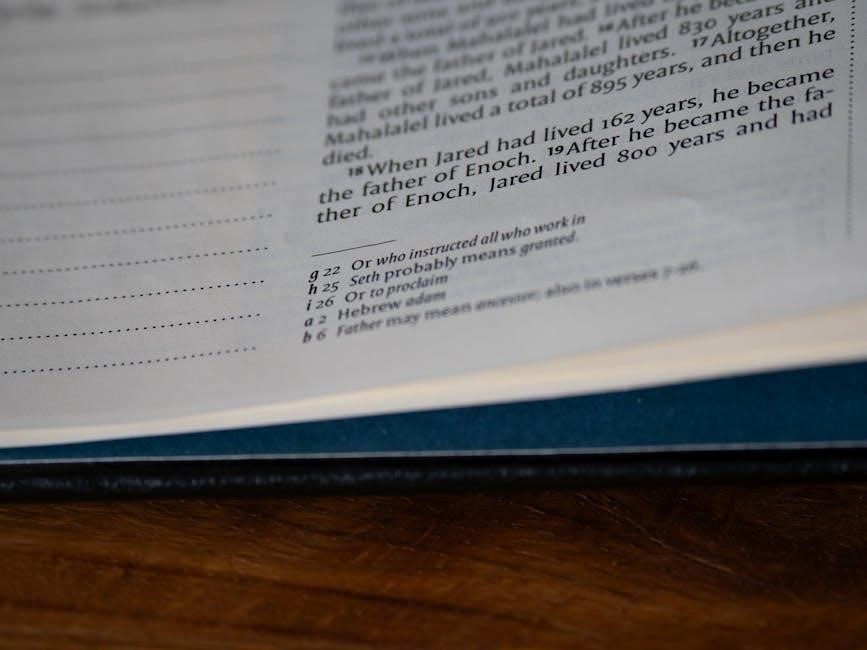
These annotations, praised for their depth, don’t dictate interpretation but equip readers with the necessary information to analyze the text independently, fostering a deeper understanding of the biblical narrative.
Essays on Biblical Topics
The NOAB PDF includes comprehensive essays addressing crucial themes in biblical studies. These scholarly pieces delve into historical context, literary criticism, and theological interpretations.
They provide a broader understanding of the biblical world, covering essential topics that enhance comprehension and facilitate informed discussion, making the NOAB a robust academic tool.
Maps, Timelines, and Glossaries
The NOAB PDF features visual aids – color maps, detailed timelines, and a comprehensive glossary – to enrich contextual understanding.
These elements vividly illustrate biblical history and geography, enhancing comprehension of ancient settings and events. They serve as invaluable resources for navigating the complexities of biblical narratives and terminology.
Visual Aids for Contextual Understanding
The NOAB PDF’s inclusion of color maps and timelines provides crucial contextual understanding of biblical events.
These visual elements illuminate the geographical and historical landscapes within which the scriptures unfolded, aiding readers in grasping the cultural and political climates. They transform abstract narratives into relatable, situated realities.
Enhancing Comprehension of Biblical History
The NOAB PDF significantly enhances comprehension of biblical history through its detailed glossaries and comprehensive study materials.
These resources clarify unfamiliar terms, customs, and historical references, bridging the gap between the ancient world and modern readers. This allows for a deeper, more informed engagement with the biblical text and its historical context.
Ecumenical Approach of the NOAB
The NOAB PDF distinguishes itself with a notably ecumenical approach, representing diverse theological perspectives within its annotations and essays.
This inclusive methodology avoids denominational bias, fostering a broader understanding of biblical interpretation and promoting constructive interfaith dialogue among readers from varied backgrounds.
Representing Diverse Theological Perspectives
The NOAB PDF’s editorial team intentionally incorporates a wide spectrum of theological viewpoints in its annotations and introductory essays.
This commitment ensures that readers encounter multiple interpretations of scripture, reflecting the richness and complexity of biblical scholarship.
It avoids presenting a single, monolithic theological stance, encouraging critical thinking and informed engagement with the text.
Promoting Interfaith Dialogue
The NOAB PDF facilitates interfaith understanding by presenting the biblical text within its historical and cultural context, accessible to diverse audiences.
Its ecumenical approach, showcasing varied theological perspectives, fosters respectful conversation between different faith traditions.
By providing scholarly insights, it encourages a nuanced appreciation of shared Abrahamic roots and promotes constructive dialogue.
Comparison with Other Study Bibles
The NOAB PDF distinguishes itself through its extensive scholarly apparatus, surpassing many study Bibles in depth of annotation and essay content.
Compared to the NIV or ESV Study Bibles, it offers a broader ecumenical perspective and a more critical, historically-focused approach to the text.
While others prioritize devotional aspects, NOAB excels as an academic resource.
NOAB vs. NIV Study Bible
The NOAB PDF contrasts with the NIV Study Bible in translation philosophy and annotation style. The NIV prioritizes readability, while NOAB utilizes the NRSV, favored for scholarly accuracy.
NOAB’s notes are more historically and critically oriented, delving into textual complexities.
The NIV leans towards a more conservative theological viewpoint, whereas NOAB presents diverse perspectives.
NOAB vs. ESV Study Bible
The NOAB PDF differs from the ESV Study Bible in its approach to biblical interpretation. The ESV emphasizes formal equivalence, aiming for a literal translation, while NOAB’s NRSV balances accuracy with clarity.
NOAB provides extensive scholarly apparatus, including detailed footnotes and essays, exceeding the ESV’s scope.
The ESV generally reflects a more traditionally conservative theological stance, unlike NOAB’s ecumenical approach.
Reviews and Reception of the NOAB
The NOAB PDF consistently receives critical acclaim as an unparalleled study Bible. Darrell Sutton, in The Quarterly Review, highlights its wealth of historical detail and anticipates a broad readership.
Users praise the comprehensive annotations and scholarly essays, equipping them to form informed opinions.
Its ecumenical nature is also frequently lauded, making it suitable for diverse theological perspectives.
Critical Acclaim and Recognition
The NOAB PDF is widely recognized within academic circles as a premier study resource. The Quarterly Review specifically notes the Bible’s abundance of historical details, predicting significant readership.
Scholars appreciate the robust scholarly apparatus – footnotes and essays – fostering critical engagement with the text.

Its long-standing reputation, spanning over 50 years, solidifies its position as an authoritative guide.
User Feedback and Testimonials

The NOAB PDF consistently receives positive feedback, particularly from students, professors, and clergy seeking a comprehensive study Bible.
Users highlight its extensive annotations as invaluable for deeper understanding and critical analysis of scripture.
Many appreciate the inclusion of the Apocrypha and the ecumenical approach, offering diverse perspectives.
The digital PDF format enhances accessibility and convenience for modern Bible study.
Future of the NOAB
The NOAB’s future likely involves a fifth edition, adapting to evolving biblical scholarship and archaeological discoveries.
Updates will incorporate new insights and address ongoing scholarly debates, maintaining its position as a leading study resource.
A digital focus, enhancing the PDF’s interactive features, is probable.
Continued commitment to ecumenical perspectives and accessibility will remain central to future development.
Potential for Fifth Edition
A fifth edition of the NOAB PDF is anticipated, driven by ongoing biblical research and the need for updated annotations.
This edition could feature revised essays, reflecting current scholarly consensus and addressing emerging theological questions.
Enhanced digital features within the PDF, like improved searchability and interactive maps, are also likely.
Maintaining its ecumenical approach while incorporating new discoveries remains a key goal.
Adapting to New Scholarship
The NOAB PDF continually evolves, integrating the latest archaeological findings and textual criticism.
New scholarship on the historical context of biblical texts will be reflected in updated annotations and introductory essays.
The digital format allows for easier incorporation of these changes, providing users with the most current information.
This commitment to academic rigor ensures the NOAB remains a trusted resource for biblical study.